Healthy habits that start early tend to last. Looking after your child’s teeth from the very first tooth helps protect them from decay, makes dental visits easier, and teaches routines they can carry into adulthood.
The trouble is that the advice changes as children grow. How much toothpaste should a toddler use? When can children brush on their own? When should they first see a dentist? This guide brings together NHS guidance into a simple, age-by-age plan you can follow at home.
This article is for general educational purposes and is not a substitute for professional advice. Please see our medical disclaimer. Always follow the advice of your child’s dentist.
Why Children’s Teeth Need Care From Day One
Milk teeth may eventually fall out, but they still matter. They help children eat and speak, and they hold space for adult teeth. The NHS notes that tooth decay is common in children, so it is important to help them look after their teeth and gums from an early age.
Tooth decay starts when bacteria in plaque turn sugars into acid that weakens tooth enamel. Our guide to tooth decay and cavities explains the process. The good news is that a regular brushing routine with fluoride toothpaste, plus sensible eating habits, goes a long way.
Toothbrushing by Age
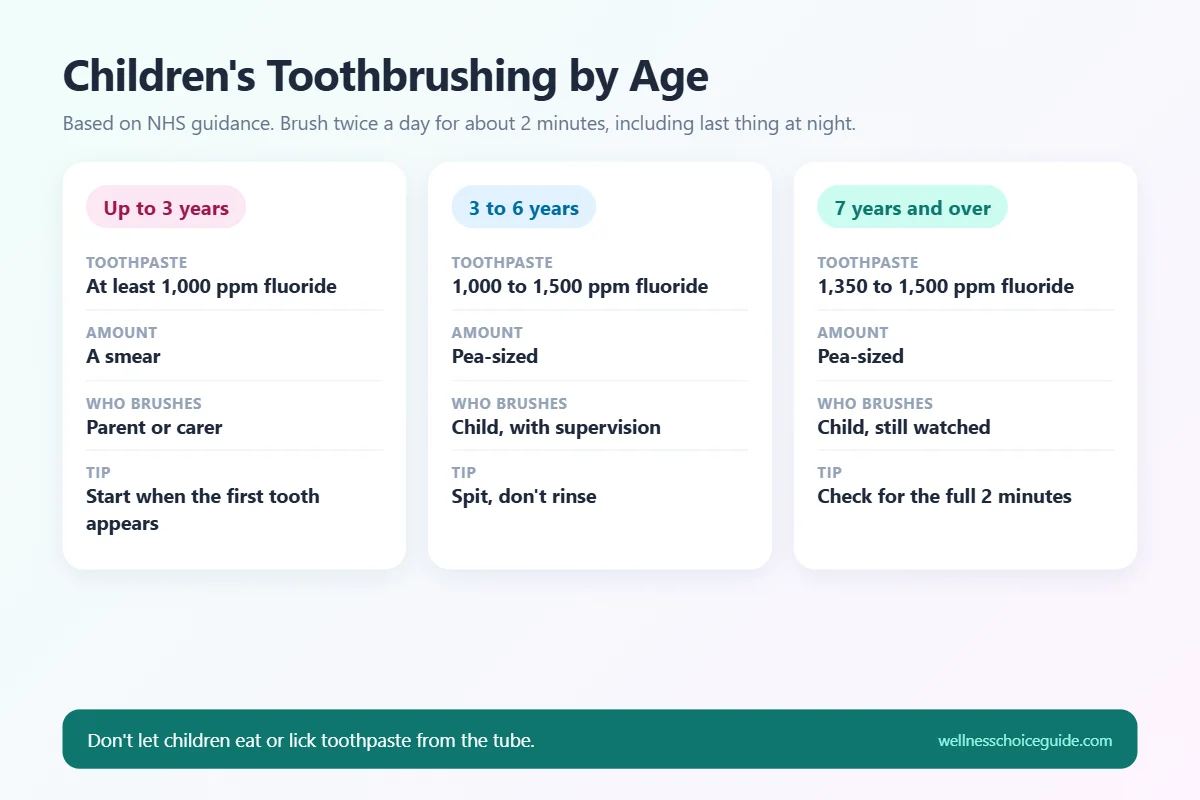
The NHS recommends using a fluoride toothpaste, as it helps prevent and control tooth decay. Here is how its advice changes with age.
Children Up to 3 Years
- Start brushing as soon as the first milk tooth breaks through, usually at around 6 months, although it can be earlier or later.
- Parents or carers should do the brushing.
- Brush twice a day for about 2 minutes, including last thing at night before bed.
- Use a children’s fluoride toothpaste containing no less than 1,000 ppm fluoride, unless a dentist advises a family toothpaste with a higher level.
- Use only a smear of toothpaste.
- Make sure children don’t eat or lick toothpaste from the tube.
Children Aged 3 to 6
- Brush at least twice a day for about 2 minutes, including last thing at night.
- Encourage your child to brush their own teeth while you supervise.
- Use a toothpaste with 1,000 to 1,500 ppm fluoride.
- Use a pea-sized amount.
- Spit out after brushing and don’t rinse. The NHS explains that if you rinse, the fluoride won’t work as well.
Children Aged 7 and Over
- Brush at least twice a day for about 2 minutes, including last thing at night.
- Use a toothpaste with 1,350 to 1,500 ppm fluoride.
- Spit out after brushing and don’t rinse.
- Children of this age should be able to brush their own teeth, but it is still a good idea to watch them to make sure they brush properly and for long enough.
The fluoride level is printed on the toothpaste box, usually as “ppm F.” For more detail, see our guide to using fluoride toothpaste.
How to Help Children Brush Properly
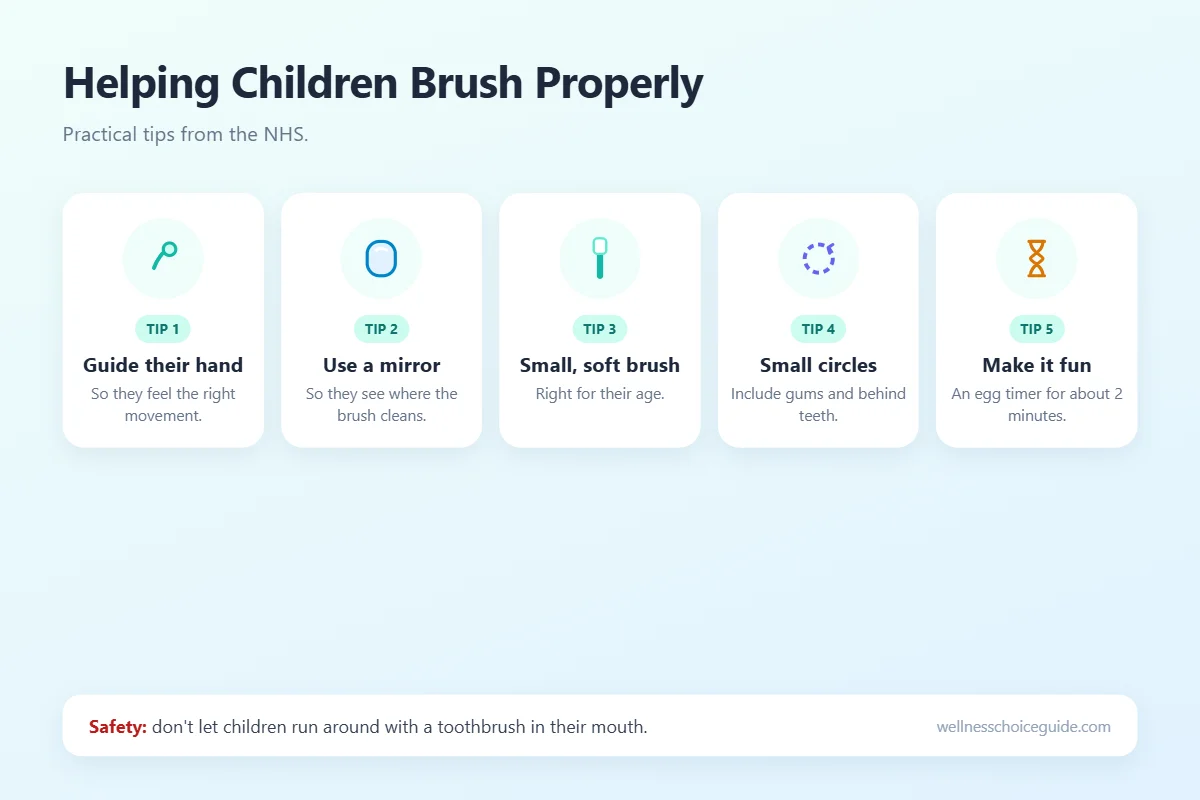
The NHS offers these practical tips:
- Guide your child’s hand so they can feel the correct movement.
- Use a mirror so your child can see exactly where the brush is cleaning.
- Choose a small, soft toothbrush that is right for your child’s age.
- Brush using small, circular movements, and gently brush the gums and behind the teeth.
- Make it fun, for example by using an egg timer for about 2 minutes.
- Stay safe: don’t let children run around with a toothbrush in their mouth, as they could hurt themselves.
Many parents find it easier to brush a young child’s teeth from behind, with the child’s head gently supported, so you can see into their mouth. A favorite song or a sticker chart can also help turn brushing into a routine rather than a battle.
Your Child’s First Dental Visit
The NHS advises taking your child to the dentist when their first milk teeth appear, or before they are 12 months old. Early visits help children become familiar with the environment and get to know the dentist. The dentist can also advise you on preventing decay and spot any problems early.
Even just letting the dentist take a look is useful practice. The NHS suggests being positive about the visit and making the trip fun, so your child is less likely to worry about future appointments. After that, take your child for regular check-ups as advised by the dentist. Our guide on how often to see a dentist explains how check-up intervals work.
Fluoride Varnish and Fissure Sealants
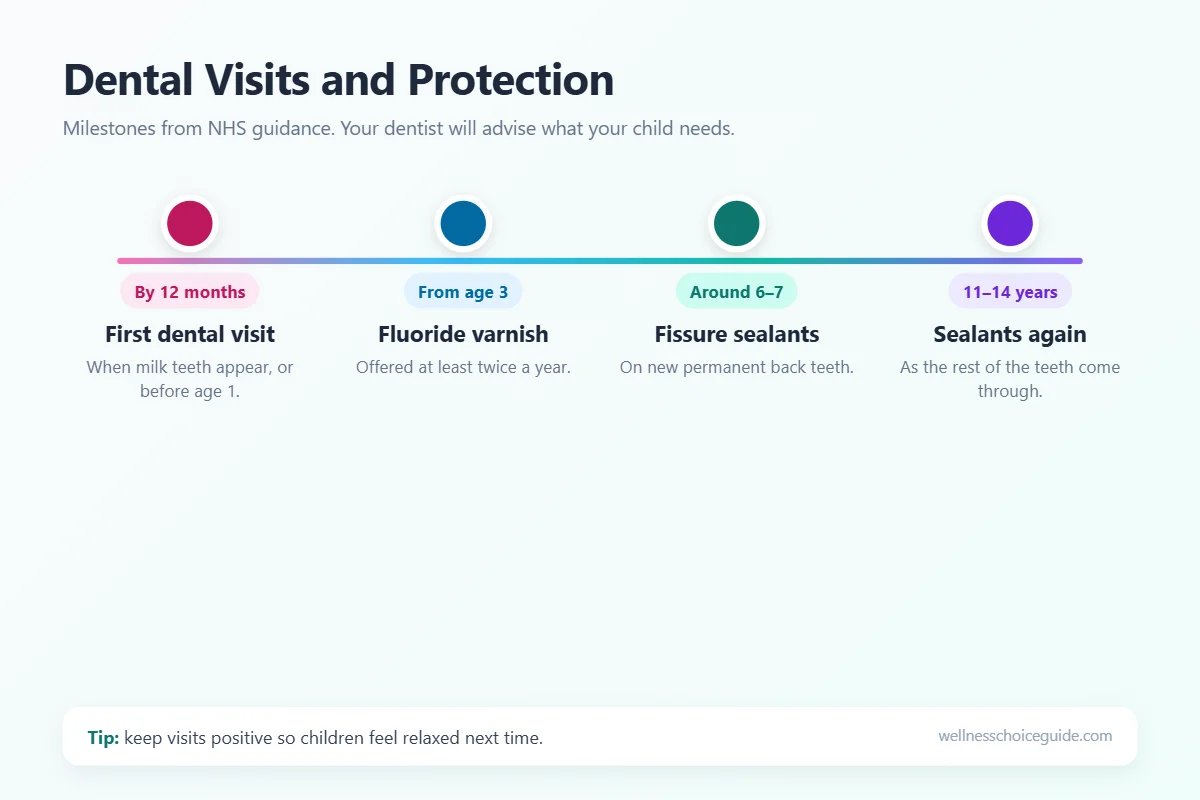
Dentists can offer extra protection for children’s teeth:
- Fluoride varnish is a high-fluoride varnish painted onto the teeth to help strengthen enamel and make it more resistant to decay. The NHS says children should be offered fluoride varnish at least twice a year from the age of 3, and younger children may be offered it if the dentist thinks they need it.
- Fissure sealants are a thin plastic coating applied to the chewing surfaces of the back teeth to keep germs and food out of the grooves. The NHS notes they can be done once the permanent back teeth start to come through, usually around age 6 or 7, and again when the rest come through between 11 and 14. A sealant can last up to 4 years.
Ask your child’s dentist whether these treatments are right for them.
Food, Drinks, and Children’s Teeth
What children eat and drink affects their teeth as much as brushing does. The NHS recommends that children aged 4 to 6 have no more than 19 g of free sugars a day, and children aged 7 to 10 no more than 24 g. Some simple habits help:
- offer water or milk between meals rather than sugary drinks;
- keep sweet foods and treats to mealtimes rather than spreading them through the day;
- choose sugar-free medicines where possible;
- check food labels, since many snacks marketed to children contain added sugar.
Our sister site has a detailed guide on how much sugar per day is recommended, including tips for reading labels.
A Simple Age-by-Age Checklist
Use this as a quick reminder you can save or print:
- First tooth (around 6 months): start brushing twice a day with a smear of fluoride toothpaste.
- Before 12 months: book a first dental visit.
- Age 3: switch to a pea-sized amount, start encouraging your child to brush while you supervise, and ask about fluoride varnish.
- Age 6 to 7: ask about fissure sealants as permanent back teeth come through.
- Age 7 and over: use a toothpaste with 1,350 to 1,500 ppm fluoride, and keep checking they brush for the full 2 minutes.
- Age 11 to 14: ask about sealants for newly erupted back teeth.
- Every day: brush last thing at night, spit don’t rinse, and limit sugary snacks and drinks.
When to See a Dentist Sooner
Don’t wait for the next check-up if your child has toothache, sore or bleeding gums, visible spots or holes in their teeth, or swelling in the mouth or face. Our guide to toothache explains what to do while you wait for an appointment, including the NHS advice that children under 16 should not take aspirin.
Frequently Asked Questions
When should I start brushing my baby’s teeth?
As soon as the first milk tooth appears, usually around 6 months. Use a smear of fluoride toothpaste twice a day.
How much toothpaste should a child use?
A smear for children under 3, and a pea-sized amount for children aged 3 and over.
When can children brush their own teeth?
Children aged 3 to 6 can start brushing with supervision. From age 7, most can brush on their own, but it is still worth checking.
When should a child first see a dentist?
The NHS recommends a first visit when milk teeth appear, or before 12 months of age.
Should children rinse after brushing?
No. Encourage them to spit out excess toothpaste but not rinse, so the fluoride keeps working.
The Bottom Line
Start brushing as soon as the first tooth appears, use the right amount of fluoride toothpaste for your child’s age, and supervise brushing until they can do it well on their own. Book a first dental visit before 12 months, ask about fluoride varnish and fissure sealants, and keep sugary foods and drinks to mealtimes.
These small, consistent habits give children the best chance of healthy teeth for life.
Sources and Further Reading
- NHS: Taking care of children’s teeth
- NHS: Tooth decay
- NHS: Sugar: the facts