

When choosing an oral probiotic, most people focus on the ingredients first.
They look at:
- probiotic strains;
- CFU numbers;
- added ingredients;
- serving size;
- and product format.
But there is another practical detail that is often overlooked:
How should the product be stored?
Storage matters because probiotic supplements contain microorganisms, and different products may have different stability requirements.
Some people assume every probiotic needs refrigeration.
Others assume all supplements can simply be stored anywhere.
The reality is more complicated.
The correct answer depends on the specific product, formulation, packaging, and manufacturer instructions.
Understanding storage information can help you use an oral probiotic properly and avoid common mistakes

Why Does Storage Matter for Probiotics?
The word “probiotic” refers to products containing live microorganisms.
Because these microorganisms are sensitive biological materials, environmental conditions can influence their stability.
Factors such as:
- temperature;
- moisture;
- light exposure;
- air exposure;
- and time
can affect how well a product maintains its intended quality during its shelf life.
This does not mean every probiotic product is fragile.
Modern supplement manufacturing uses different technologies to help protect ingredients.
However, storage instructions exist for a reason.
Do All Oral Probiotics Need Refrigeration?

No.
There is no universal rule that all oral probiotics must be refrigerated.
Some products are designed to remain stable at room temperature.
Others may recommend refrigeration after opening or throughout storage.
The correct approach is simple:
Follow the storage instructions provided by the manufacturer.
Do not assume that:
- refrigeration is always better;
- room temperature is always acceptable;
- or one probiotic product can be stored exactly like another.
Different formulas can have different requirements.
How to Read Storage Instructions on a Label

Storage information is usually found on:
- the bottle label;
- packaging box;
- product website;
- or manufacturer instructions.
Look for phrases such as:
- “store in a cool, dry place”;
- “refrigerate after opening”;
- “keep refrigerated”;
- “protect from moisture”;
- “avoid excessive heat.”
These instructions tell you how the product was designed to be handled.
For more information about reading supplement labels, see our guide:
Oral Probiotic Labels Explained: What the Supplement Facts Panel Really Means
Room Temperature vs. Refrigerated Probiotics
Both storage approaches can exist.
Room Temperature Products
Some probiotic supplements are designed with packaging and manufacturing methods intended to maintain stability without refrigeration.
This can make them more convenient for:
- travel;
- office storage;
- daily routines;
- and simpler storage.
However, room-temperature stability does not mean unlimited storage.
The expiration date and storage instructions still matter.
Refrigerated Products
Some products may require refrigeration because the manufacturer recommends colder conditions to help maintain stability.
This can create additional considerations:
- Do you have enough refrigerator space?
- Can you maintain consistent storage conditions?
- Is the product practical for travel?
Again, the manufacturer’s instructions should guide your decision.
Shelf Life Is Different From Storage
A common misunderstanding is thinking:
“If I store it correctly, it will last forever.”
That is not true.
Every supplement has a shelf life.
The expiration date represents the period during which the manufacturer expects the product to maintain its stated quality when stored according to instructions.
Storage helps protect the product.
It does not extend the expiration date indefinitely.
Always check:
- expiration date;
- opening instructions;
- packaging condition;
- and storage recommendations.
Why Moisture Can Be a Problem
Many oral probiotic products come as:
- tablets;
- lozenges;
- chewables.
Moisture can affect some supplement formats.
That is why you may see instructions such as:
- keep the container tightly closed;
- avoid storing in humid areas;
- do not remove protective packaging;
- keep away from bathroom humidity.
A bathroom cabinet may seem like the obvious place for oral-care products.
But bathrooms often experience temperature changes and humidity from showers.
For some supplements, a dry storage location may be more appropriate.
Common Storage Mistakes
Even a well-formulated product can be affected by poor storage habits.
Common mistakes include:
1. Leaving the Bottle in Direct Sunlight
Heat and light exposure can create unnecessary stress on supplement ingredients.
Avoid places such as:
- car dashboards;
- windowsills;
- hot countertops.
2. Keeping Supplements in Humid Areas
Humidity may affect some tablets and packaging.
Consider storing products in a dry location unless the instructions say otherwise.
3. Ignoring the Expiration Date
Buying a large supply does not help if you cannot use it before expiration.
Storage and timing should be considered together.
4. Assuming All Probiotics Are Stored the Same Way
A digestive probiotic, oral probiotic, and other supplement types may have different recommendations.
Always check the specific product.
Traveling With Oral Probiotics
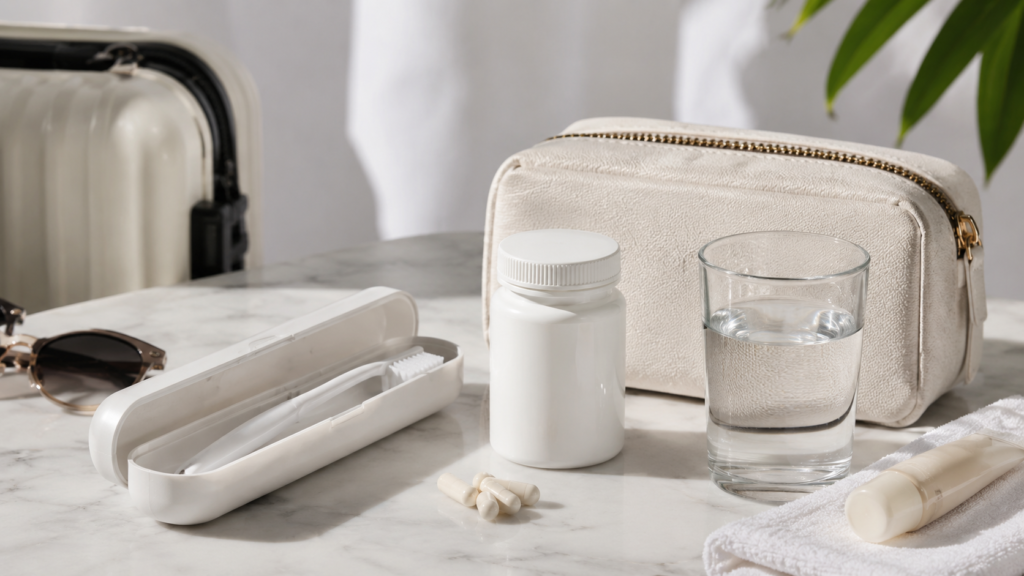
Travel creates another storage challenge.
People often ask:
Can I bring oral probiotics on a trip?
In many situations, the answer depends on the product instructions.
Before traveling:
- check whether refrigeration is required;
- keep the product in its original container;
- avoid excessive heat;
- protect it from moisture;
- follow the label recommendations.
For short trips, convenience may be an important factor when choosing a supplement format.
A product that fits your lifestyle is easier to use consistently.
Storage Should Be Part of Your Buying Decision
Storage is not usually the first thing people consider when choosing an oral probiotic.
They often focus on:
- ingredients;
- price;
- brand;
- or marketing claims.
But practical questions matter too.
Before choosing a product, consider:
- Can I store it correctly?
- Does the storage requirement fit my lifestyle?
- Will I realistically use it before expiration?
- Is the format convenient?
A product that fits your daily routine may be easier to maintain consistently.
Ingredients and Storage Work Together
Storage information is only one part of evaluating an oral probiotic.
You should also understand what is inside the product.
Look at:
- probiotic strains;
- supporting ingredients;
- serving information;
- directions;
- and storage instructions.
For a deeper look at what ingredients may appear in oral probiotic formulas, read:
Oral Probiotic Ingredients Explained: What to Look for Beyond the Front Label
Storage Does Not Replace Good Oral Care
Even the best-stored supplement should be viewed as an optional addition to your routine.
An oral probiotic does not replace:
- brushing;
- cleaning between teeth;
- dental checkups;
- professional treatment;
- or addressing ongoing symptoms.
If you experience persistent concerns such as pain, bleeding gums, or other oral changes, professional guidance is important.
A Simple Oral Probiotic Storage Checklist
Before storing your product, check:
✅ What does the label recommend?
✅ Does it require refrigeration?
✅ Is it protected from moisture?
✅ Is it away from heat and sunlight?
✅ Is the expiration date still reasonable?
✅ Can you maintain these conditions consistently?
These simple checks can prevent avoidable mistakes.
The Bottom Line
Do oral probiotics need refrigeration?
Sometimes yes.
Sometimes no.
The correct answer depends on the specific product.
The most important rule is:
Follow the manufacturer’s storage instructions.
Proper storage helps protect the product and allows you to use it as intended.
When choosing an oral probiotic, consider the complete picture:
- ingredients;
- format;
- serving instructions;
- storage requirements;
- and whether it fits your lifestyle.
A supplement is easier to maintain when it fits naturally into your everyday routine.
Medical Disclaimer:
This article is for general educational purposes only and is not a substitute for professional dental or medical advice. Supplements are not intended to diagnose, treat, cure, or prevent dental or medical conditions. Consult a qualified healthcare or dental professional for personal advice.