
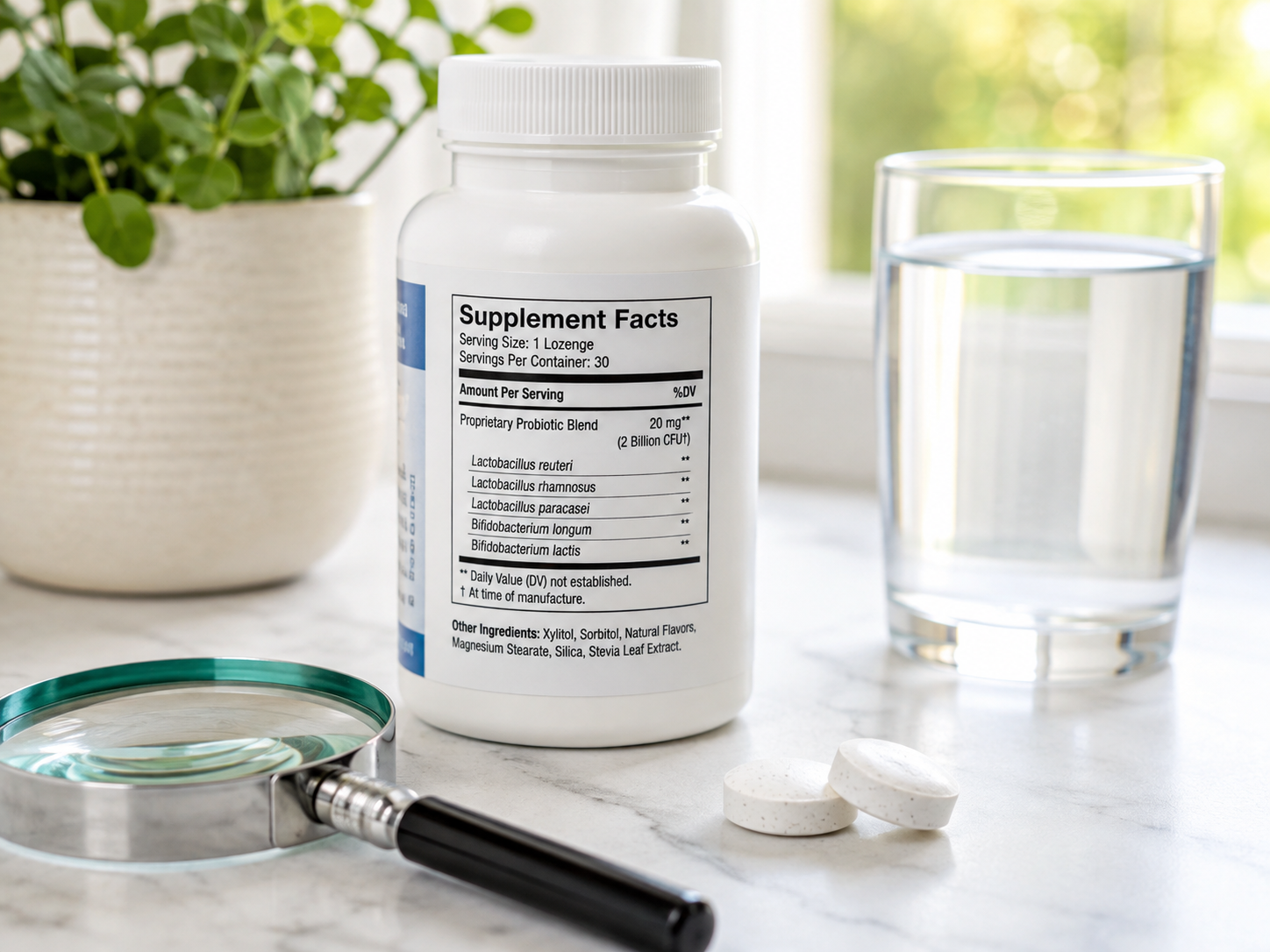
Oral Probiotic Labels Explained: What the Supplement Facts Panel Really Means
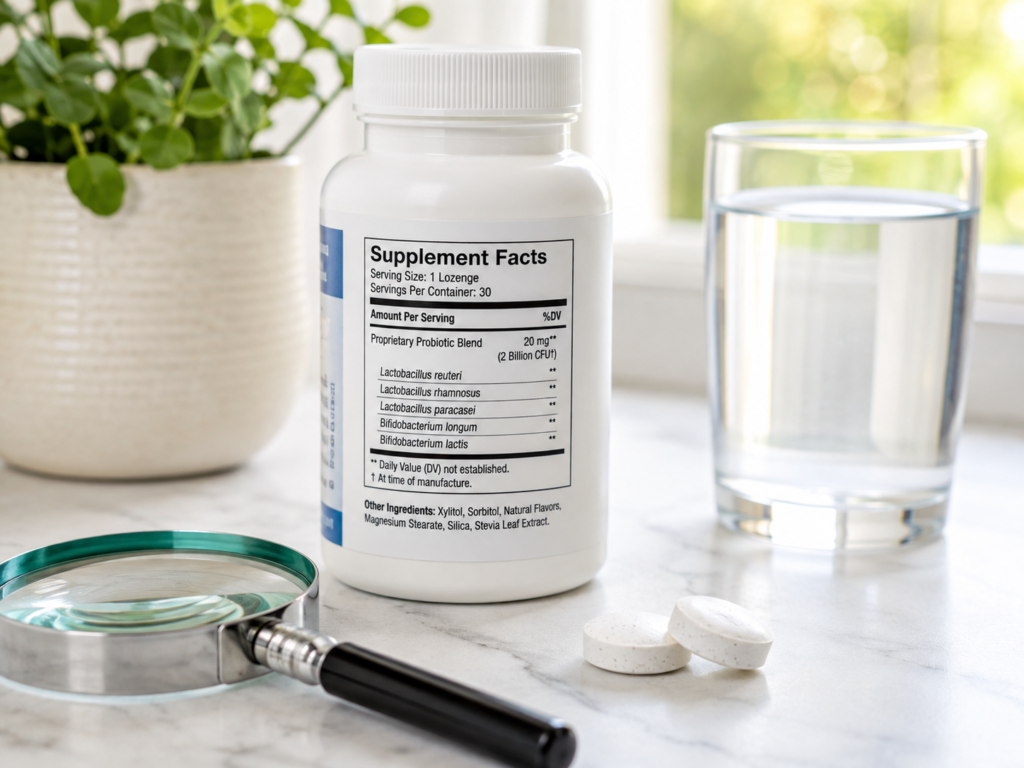
When choosing an oral probiotic, the bottle label can feel overwhelming.
You may see:
- multiple probiotic strains;
- large CFU numbers;
- added prebiotic ingredients;
- different serving sizes;
- and various claims about oral wellness.
At first glance, it may seem like the product with the biggest numbers or longest ingredient list is the best choice.
But supplement labels are not designed to be read only from the front of the bottle.
The most useful information is usually found in the Supplement Facts panel and the ingredient list.
Learning how to read these details can help you compare oral probiotic products more confidently and understand what you are actually buying.
Why Reading the Label Matters
Many supplement decisions are influenced by marketing.
A product may highlight:
- “advanced formula”;
- “multi-strain blend”;
- “microbiome support”;
- “high potency”;
- or “with prebiotics.”
These phrases may sound impressive, but they do not tell you everything about the product.
A better approach is to look at the details behind the claims.
The label can help answer questions such as:
- What probiotic strains are included?
- How much is provided per serving?
- How many servings are in the bottle?
- What other ingredients are included?
- How should the product be used?
Understanding those details makes it easier to compare products based on information rather than advertising.
1. Start With the Serving Size

The first thing to check is the Serving Size.
This tells you how much of the product counts as one serving.
For example:
Serving Size: 1 Tablet
means one tablet represents one labeled serving.
But another product may say:
Serving Size: 2 Tablets
That means two tablets are needed to provide the listed amount of ingredients.
This matters because people often compare bottles by tablet count alone.
A bottle with 60 tablets does not automatically provide twice as much as a bottle with 30 tablets.
The serving size changes the calculation.
For a deeper explanation, read:
How to Read an Oral Probiotic Serving Size: What the Label Really Tells You
2. Look at the Probiotic Strains
The word “probiotic” is a category, not a complete description.
Different products can contain different microorganisms and strains.
A label that says:
“Multi-strain probiotic blend”
does not tell you much unless it explains which strains are included.
When reading the label, look for:
- microorganism names;
- strain identification when available;
- amount per serving;
- and clear ingredient information.
A product with more strains is not automatically better.
More does not always mean more effective.
A transparent label is usually more useful than a long list of ingredients that are difficult to understand.
3. Understand the CFU Number
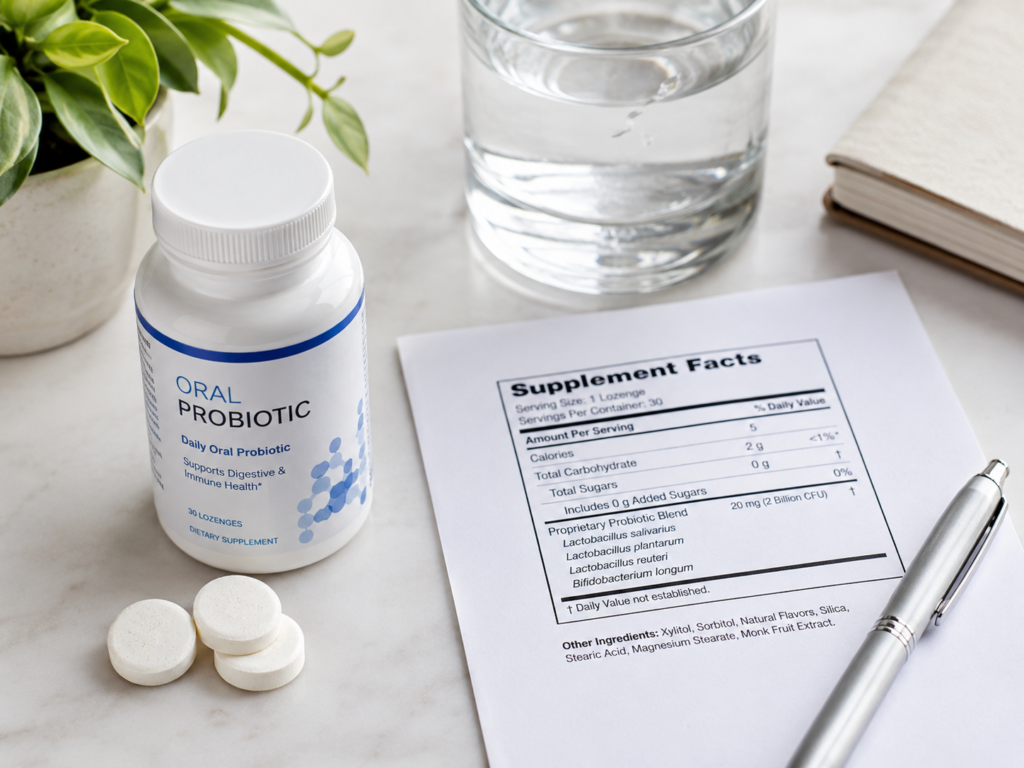
Many probiotic products highlight CFU.
CFU means colony-forming units.
It is commonly used to describe the number of viable microorganisms provided in a serving.
You may see labels showing numbers like:
- millions;
- billions;
- or higher amounts.
However, the CFU number should not be viewed alone.
A larger number does not automatically mean a better product.
You should also consider:
- which strains are included;
- how the product is designed to be used;
- serving size;
- storage instructions;
- and ingredient transparency.
The complete formula matters more than one number.
4. Check for Added Prebiotic Ingredients
Some oral probiotic supplements include prebiotic ingredients.
This can create confusion because probiotics and prebiotics are related but different.
Simply explained:
Probiotics = selected microorganisms
Prebiotics = compounds that certain microorganisms may use
A product containing both may be described as a synbiotic formula.
However, the word “prebiotic” on the label does not automatically make one product better.
Look at:
- what prebiotic ingredient is included;
- whether the amount is disclosed;
- and why it is included.
To understand the difference between these ingredients, read:
Prebiotics vs. Probiotics for Oral Wellness: What’s the Difference?
5. Review the Other Ingredients
The Supplement Facts panel is not the only place worth reading.
The ingredient list may include:
- sweeteners;
- flavoring;
- binders;
- tablet coating;
- plant extracts;
- fibers;
- or other supporting ingredients.
These ingredients may serve different purposes.
For example:
- some improve taste;
- some help maintain tablet structure;
- some may be included as part of the formula design.
A longer ingredient list is not always better.
The goal is to understand why each ingredient is there.
6. Check the Product Format
Oral probiotics come in different formats.
Common examples include:
- lozenges;
- chewable tablets;
- dissolving tablets;
- capsules;
- powders.
The format affects how the product fits into your routine.
A lozenge designed to dissolve in the mouth is different from a capsule that is swallowed immediately.
Before choosing a product, consider:
- Is this format convenient?
- Will I realistically use it consistently?
- Does it fit my daily habits?
A product that is difficult to use may become difficult to maintain.
7. Look at Directions and Storage Information

The label should also explain:
- how much to take;
- when to take it;
- how to store it;
- and any special instructions.
Storage can matter because probiotic products contain live microorganisms.
Check:
- expiration date;
- storage temperature;
- moisture protection;
- refrigeration instructions if applicable.
For more details about storage, read:
Do Oral Probiotics Need Refrigeration? Storage, Shelf Life, and Travel Tips
Be Careful With Marketing Claims
Supplement labels often use strong language.
You may see claims about:
- microbiome balance;
- freshness;
- wellness support;
- advanced formulas;
- or premium ingredients.
These descriptions can be useful, but they should be viewed carefully.
An oral probiotic should not be treated as a replacement for:
- brushing;
- cleaning between teeth;
- dental checkups;
- professional treatment.
Supplements should be considered an optional addition to a complete oral-care routine.
How to Compare Two Oral Probiotic Labels
When comparing two products, use the same checklist.
Step 1: Compare the strains
Are the probiotic microorganisms clearly identified?
Step 2: Check serving size
How much product provides one serving?
Step 3: Review the CFU information
What amount is provided per serving?
Step 4: Check supporting ingredients
Are additional ingredients clearly explained?
Step 5: Review directions
How is the product intended to be used?
Step 6: Check storage
Can you realistically store and use it properly?
This approach is more useful than choosing based only on the front label.
A Clear Label Is Often a Better Sign
A complicated formula can look impressive.
But complexity does not always mean quality.
A good supplement label should help you understand:
- what is inside;
- how much is included;
- how to use it;
- and what expectations are realistic.
Transparency makes comparison easier.
The Bottom Line
Reading an oral probiotic label does not need to be complicated.
Focus on the details that actually matter:
- probiotic strains;
- serving size;
- CFU information;
- added ingredients;
- directions;
- storage requirements;
- and realistic claims.
The biggest number on the bottle is not always the most important one.
A product with a clear label and understandable instructions can be easier to evaluate than one that relies mainly on impressive marketing language.
Learning how to read the Supplement Facts panel gives you a better foundation for making informed
Walking through the supplement aisle or browsing online, you may notice that oral probiotics come in many different forms.
Some products highlight:
- multiple probiotic strains;
- large numbers of microorganisms;
- added prebiotic ingredients;
- special delivery formats;
- or impressive-sounding microbiome claims.
With so many options, choosing an oral probiotic can quickly become confusing.
The biggest number on the label is not always the most important detail.
Instead, a smarter approach is to understand what you are actually comparing.
Before buying an oral probiotic, look at the formula, instructions, ingredients, and practical details that determine whether the product fits your routine.
Here are seven things worth checking.
1. Check the Specific Probiotic Strains
The word “probiotic” alone does not tell you everything.
Different products can contain different microorganisms.
A label that simply says:
“multi-strain probiotic”
does not provide much information unless it explains which strains are included.
When comparing products, look for:
- specific microorganism names;
- strain identification when available;
- amount per serving;
- and clear labeling.
A longer list of strains does not automatically mean a better product.
More is not always better.
A transparent label is often more useful than a product with the largest number printed on the front.
2. Look Beyond the Number of CFUs
Many probiotic products highlight CFU numbers.
CFU stands for colony-forming units, a measurement commonly used to describe viable microorganisms.
A higher number may attract attention, but it should not be the only factor you consider.
A product with a very large CFU number is not automatically the right choice.
Other questions matter too:
- Which strains are included?
- Is the serving size clear?
- How is the product designed to be used?
- Does it fit your routine?
The number alone does not tell the entire story.
3. Understand the Serving Size
One of the easiest mistakes when comparing supplements is looking only at the bottle count.
A bottle with:
60 tablets
does not always mean:
60 days of use.
The serving size changes the calculation.
For example:
Product A:
60 tablets
Serving size: 1 tablet
= 60 servings
Product B:
60 tablets
Serving size: 2 tablets
= 30 servings
The amount of product you actually receive depends on the serving information.
If you want to understand this calculation in more detail, see our guide on How to Read an Oral Probiotic Serving Size: What the Label Really Tells You.
4. Review the Delivery Format
Oral probiotics are available in different forms.
Common formats include:
- lozenges;
- chewable tablets;
- dissolving tablets;
- capsules;
- powders.
The format affects how the product fits into your routine.
For example, a lozenge designed to dissolve slowly in the mouth is used differently from a capsule that is swallowed immediately.
Before buying, ask:
- Is this format convenient for me?
- Can I realistically use it consistently?
- Does it fit my daily habits?
A product that is difficult to use may be harder to maintain.
5. Examine Supporting Ingredients
The probiotic strains are important, but they are not the only ingredients on the label.
Some products include:
- prebiotic ingredients;
- sweeteners;
- flavoring;
- binders;
- plant extracts;
- other supporting compounds.
A product containing additional ingredients is not automatically better.
Look for transparency.
Can you understand:
- what each ingredient is;
- why it is included;
- and how much is provided?
Clear information makes comparison easier.
For example, some oral probiotic products include prebiotic ingredients. Understanding why those ingredients are included can help you evaluate the complete formula instead of focusing only on marketing terms.
6. Check Storage and Shelf Life
Probiotic products can have specific storage considerations.
Before purchasing, check:
- expiration date;
- storage instructions;
- whether refrigeration is recommended;
- moisture protection;
- and how the product should be handled after opening.
A product that does not fit your storage situation may become inconvenient.
This is especially important if you are considering buying a larger supply.
7. Evaluate the Claims Carefully
Supplement marketing can sometimes sound more impressive than the information behind it.
Be cautious with claims that suggest a product can:
- replace brushing;
- fix all oral problems;
- eliminate the need for dental care;
- or guarantee specific results.
A responsible supplement should be presented as an optional addition to a broader oral-care routine.
Your foundation still includes:
- brushing;
- cleaning between teeth;
- regular dental visits;
- and addressing persistent symptoms professionally.
Should You Choose the Most Expensive Oral Probiotic?
Not necessarily.
Price does not automatically equal quality.
A higher-priced product may include:
- premium packaging;
- more ingredients;
- more servings;
- or additional features.
But the more important question is whether the product information is clear and whether it fits your needs.
A simple formula with transparent labeling may be easier to evaluate than a complicated formula with unclear details.
Single Bottle vs. Larger Supply
Some companies offer:
- single bottles;
- multi-bottle packages;
- subscription options.
A larger package may appear cheaper per bottle.
However, before buying more, consider:
- Will you actually use the product consistently?
- Does the expiration date allow enough time?
- Is the storage practical?
- Have you already decided that the product fits your routine?
Buying more is not always better if you are unsure about long-term use.
A Simple Checklist Before Buying
Before choosing an oral probiotic, ask:
✅ Are the probiotic strains clearly listed?
✅ Is the serving size easy to understand?
✅ Do I know how many servings I actually get?
✅ Is the format convenient?
✅ Are supporting ingredients transparent?
✅ Are storage instructions practical?
✅ Are the claims realistic?
These questions can help you compare products more effectively.
The Bottom Line
Choosing an oral probiotic is not only about finding the bottle with the biggest number or longest ingredient list.
A better approach is to look at the complete picture:
- probiotic strains;
- serving size;
- product format;
- supporting ingredients;
- storage requirements;
- and realistic expectations.
A clear label and a product that fits your routine are often more valuable than impressive marketing language.
The goal is not to find the most complicated formula.
The goal is to find a product you understand and can realistically use as part of a consistent oral-care routine.
Medical Disclaimer:
This article is for general educational purposes only and is not a substitute for professional dental or medical advice. Supplements are not intended to diagnose, treat, cure, or prevent dental or medical conditions. Consult a qualified healthcare or dental professional if you have persistent oral symptoms or questions about supplement use.