
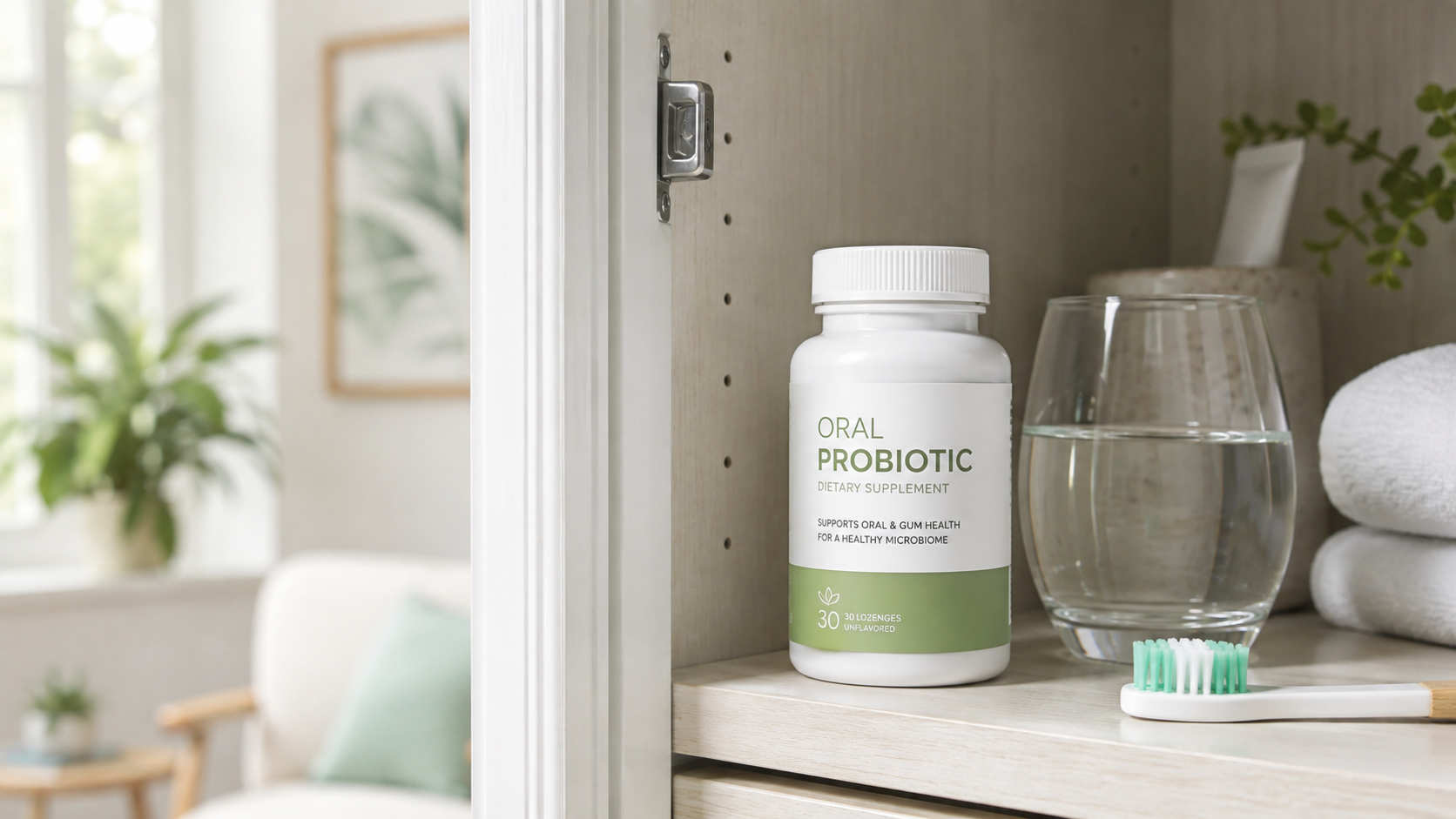
Buying an oral probiotic is only part of the equation. Where and how you store it can matter too.
Some probiotic products are designed to remain stable at room temperature, while others may have more specific storage requirements. That can make instructions such as “store in a cool, dry place” or “refrigerate after opening” easy to overlook.
So, do oral probiotics need refrigeration?
Not always.
The right answer depends on the specific product, its formulation, packaging, and the manufacturer’s storage instructions. Instead of assuming that every probiotic belongs in the refrigerator, it is better to understand what can affect the product and how to store it properly.
Here is a practical guide.
Why Storage Matters for Oral Probiotics
Oral probiotics typically contain selected microorganisms intended for use as part of an oral wellness routine.
Unlike many conventional tablets that contain only vitamins, minerals, or other stable ingredients, probiotic products may contain microorganisms whose viability can be affected by environmental conditions.
Three factors are especially worth paying attention to:
- heat
- moisture
- storage time
That does not mean your probiotic will immediately become unusable if it spends a few minutes outside ideal conditions. It simply means proper storage helps give the product the best chance of remaining within the specifications intended by the manufacturer.
If you are still learning what oral probiotics are supposed to do, start with our guide to what oral probiotics do and how they may fit into daily oral care.
Do All Oral Probiotics Need to Be Refrigerated?
No.
Many modern probiotic supplements are formulated and packaged to be shelf-stable, meaning they are designed to be stored at normal room temperature under appropriate conditions.
Others may recommend refrigeration.
The most reliable source is therefore not a general rule about probiotics—it is the instructions printed on the specific product.
Look for phrases such as:
- “Store in a cool, dry place”
- “Keep below a specified temperature”
- “Refrigerate after opening”
- “Refrigeration recommended”
- “Refrigeration not required”
If the label does not require refrigeration, placing the product in the refrigerator is not automatically better.
Cold environments can introduce their own issues, particularly condensation or moisture when a container is repeatedly taken in and out.
The simple rule is:
Follow the storage instructions for the exact product you purchased.
What Does “Store in a Cool, Dry Place” Actually Mean?
This instruction appears on many supplement labels, but it can feel vague.
In everyday terms, a cool, dry place usually means an indoor location away from excessive heat, direct sunlight, steam, and humidity.
Good examples may include:
- a bedroom cabinet
- a kitchen cupboard away from the stove
- a pantry with stable room temperature
- a closed storage cabinet away from windows
Less ideal locations include:
- inside a parked car
- directly beside a stove or oven
- on a sunny windowsill
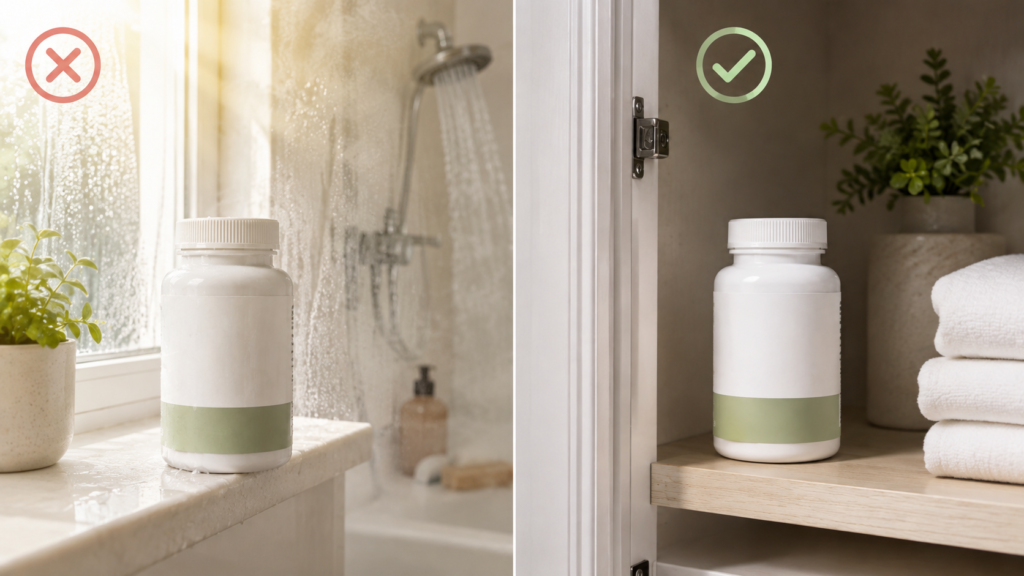
- beside a shower
- anywhere regularly exposed to steam or high humidity
Interestingly, the bathroom medicine cabinet—the place many people naturally keep oral care products—is not always ideal for supplements because bathrooms can become warm and humid after showers.
Heat Can Be Easy to Overlook
One of the most common storage problems does not happen inside the home.
It happens in the car.
A vehicle parked outdoors can become significantly hotter than the surrounding air. Leaving a probiotic supplement inside a glove compartment, center console, or bag in the car for long periods may expose it to unnecessary heat.
The same principle applies to packages delivered to your home.
If you order supplements online during very hot weather, it is generally sensible to bring the package indoors rather than leaving it outside for an extended period.
This does not mean a brief exposure automatically ruins a product. Storage recommendations vary widely. When in doubt about a particular product that has experienced unusual heat exposure, the manufacturer is the best source for product-specific guidance.
Moisture Matters Too
Humidity can be easy to underestimate.
Repeated exposure to moisture can affect many types of supplements, which is one reason bottles often contain protective packaging and tightly sealed caps.
A few practical habits can help:
- close the container firmly after each use
- avoid handling tablets or lozenges with wet hands
- do not leave the container open unnecessarily
- avoid routinely storing the bottle beside a sink or shower
- keep any manufacturer-provided moisture-control packet in place unless instructed otherwise
You should also be cautious about transferring the entire supply into a decorative jar or weekly organizer.
Convenience is useful, but the original container may provide better protection from light, humidity, and air.
Should You Keep Oral Probiotics in a Pill Organizer?
For short-term organization, some people use pill boxes to simplify their routine.
However, there is a difference between placing a small number of doses into an organizer for convenience and transferring an entire bottle for long-term storage.
The manufacturer’s original packaging was designed for that product.
If storage stability is important, keeping most of the supply in the original container is usually the simpler approach.
This is especially relevant when comparing different products. Packaging and storage requirements are among the practical details worth considering alongside ingredients and format.
Our guide on how to choose an oral probiotic covers several other factors worth reviewing before buying.
What About the Expiration Date?
Storage and expiration dates work together.
A manufacturer may design a product to meet certain specifications through its stated shelf life when it is stored according to instructions.
That is why the expiration or best-by date should not be ignored.
Check the packaging for:
- expiration date
- lot number
- storage instructions
- instructions for use after opening
If a product is far beyond its labeled date, simply assuming it is equivalent to a fresh bottle is not a good idea.
When purchasing several bottles at once, check that the expected shelf life makes sense for how quickly you expect to use them.
Can You Travel With Oral Probiotics?
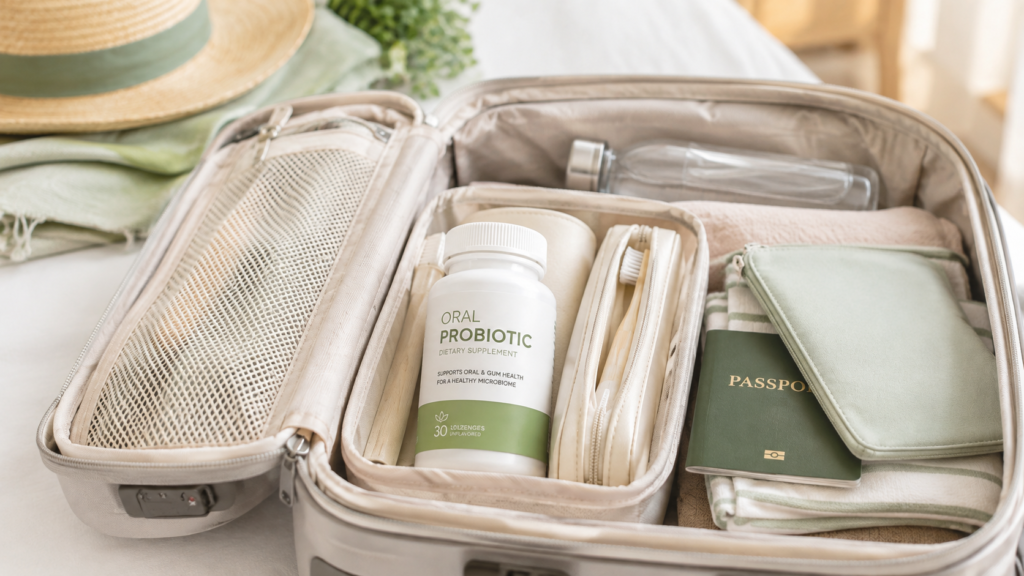
Usually, travel is manageable with a little preparation.
If your product is shelf-stable, the main priorities are protecting it from excessive heat, moisture, and damage.
Consider keeping it:
- in its original container
- inside your carry-on rather than a hot vehicle for long periods
- away from direct sunlight
- securely closed
If the product specifically requires refrigeration, follow the manufacturer’s travel recommendations.
You may need an insulated container or another temperature-management method, but avoid assuming that freezing is appropriate. Very cold temperatures are not necessarily better unless the manufacturer says so.
For flights or international travel, it can also be useful to keep supplements in their original labeled packaging.
Does Refrigeration Make a Shelf-Stable Probiotic Better?
Not necessarily.
This is an important distinction.
If a product has been formulated to remain stable at room temperature, refrigeration does not automatically make it stronger or more effective.
Instead, improper refrigeration could potentially expose the bottle to moisture through condensation, particularly if it is repeatedly moved between cold and warm environments.
That is why “colder is better” is not a useful universal rule.
Correct storage is better.
And correct storage starts with the label.
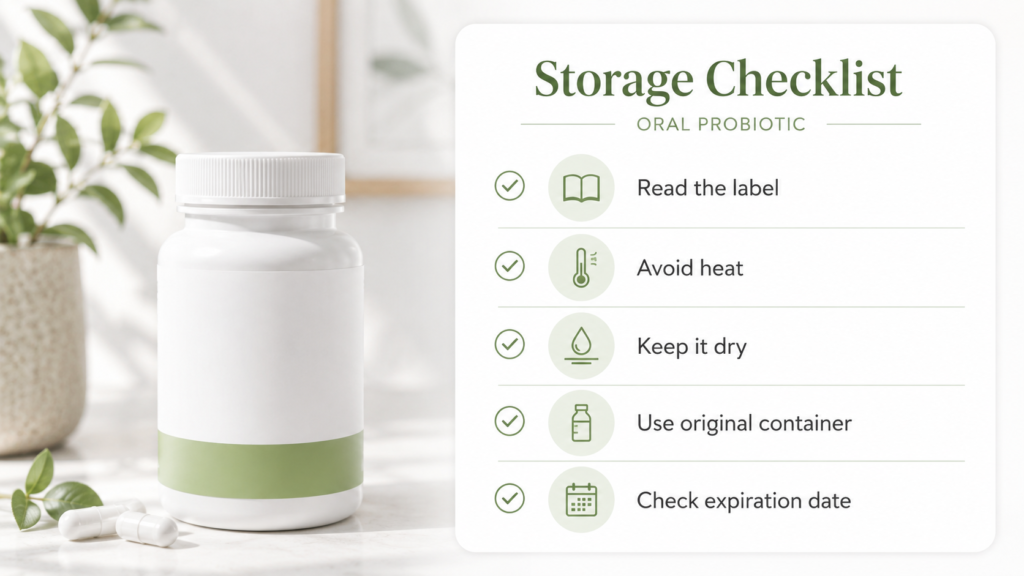
A Simple Oral Probiotic Storage Checklist
Before deciding where to keep your oral probiotic, check five things:
1. Read the label
Look for specific temperature or refrigeration instructions.
2. Avoid unnecessary heat
Do not routinely leave the product in hot vehicles or direct sunlight.
3. Keep the container dry
Avoid humid storage locations and close the lid after use.
4. Keep the original packaging
Unless there is a good reason to transfer individual doses, the original container is generally the easiest long-term storage option.
5. Check the expiration date
Especially if you purchase multiple bottles at once.
These small habits can make supplement storage far less complicated.
Storage Is Only One Part of the Routine
Proper storage matters, but it is not the main purpose of an oral wellness routine.
An oral probiotic should not replace foundational habits such as regular brushing, interdental cleaning, appropriate dental care, and other routines recommended by your dental professional.
For a broader overview, see our practical morning-to-night oral care routine.
You can also read our introductory guide to oral probiotics and oral wellness if you want more context before deciding whether this type of supplement fits your routine.
Frequently Asked Questions
Do oral probiotics have to stay in the refrigerator?
Not all of them. Some products are shelf-stable, while others may recommend or require refrigeration. Follow the instructions on the specific product.
Where is the best place to store oral probiotics?
If refrigeration is not required, a cool, dry indoor cabinet away from direct sunlight, steam, and significant temperature changes is usually more appropriate than a hot or humid location.
Is the bathroom a good place to keep oral probiotics?
It may not be ideal because bathrooms can experience frequent humidity and temperature changes. Check the manufacturer’s storage instructions.
Can I leave oral probiotics in my car?
Avoid routinely storing supplements in a parked vehicle, particularly during hot weather, because interior temperatures can become much higher than normal room temperature.
Can I travel with oral probiotics?
In many cases, yes. Keep the product properly sealed and follow its storage requirements. Products requiring refrigeration may need additional temperature management.
Can I use an oral probiotic after its expiration date?
It is better to follow the labeled expiration or best-by date and the manufacturer’s guidance rather than assuming the product will maintain the same characteristics indefinitely.
The Bottom Line
So, do oral probiotics need refrigeration?
Some do, but many do not.
Modern oral probiotic products can have very different formulations and packaging, so there is no universal storage rule.
Instead of automatically putting every bottle in the refrigerator, check the label and focus on the basics: protect the product from excessive heat, moisture, direct sunlight, and inappropriate long-term storage.
A few seconds spent reading the storage instructions can help you take better care of the product you already purchased—and make your daily oral wellness routine a little easier to manage.
This article is for general educational purposes and is not a substitute for personalized medical or dental advice.