

Oral probiotics have become easier to find in recent years. A quick search can bring up lozenges, chewable tablets, powders, and supplements that all promise to support the oral microbiome in slightly different ways. If you’re new to the topic, start with our guide to oral probiotics and how they may support oral wellness.
That variety can be useful, but it also makes choosing a product more confusing.
Two oral probiotics may look similar on the front of the package while having very different strains, serving instructions, added ingredients, and prices. And because probiotics are not the same as toothpaste or mouthwash, comparing them requires a slightly different approach.
The goal is not to find the product with the biggest number on the label or the boldest marketing claim.
Instead, it helps to ask a few practical questions:
- What probiotic strains are actually included?
- Is the product designed specifically for oral use?
- How will you take it?
- What other ingredients are included?
- Is the label transparent?
- Does the cost make sense for regular use?
- And, most importantly, does it realistically fit your oral-care routine?
Here are seven factors worth comparing before buying an oral probiotic.having very different strains, serving instructions, added ingredients, and prices. And because probiotics are not the same as toothpaste or mouthwash, comparing them requires a slightly different approach.
The goal is not to find the product with the biggest number on the label or the boldest marketing claim.
Instead, it helps to ask a few practical questions:
- What probiotic strains are actually included?
- Is the product designed specifically for oral use?
- How will you take it?
- What other ingredients are included?
- Is the label transparent?
- Does the cost make sense for regular use?
- And, most importantly, does it realistically fit your oral-care routine?
Here are seven factors worth comparing before buying an oral probiotic.
1. Look at the Specific Probiotic Strains
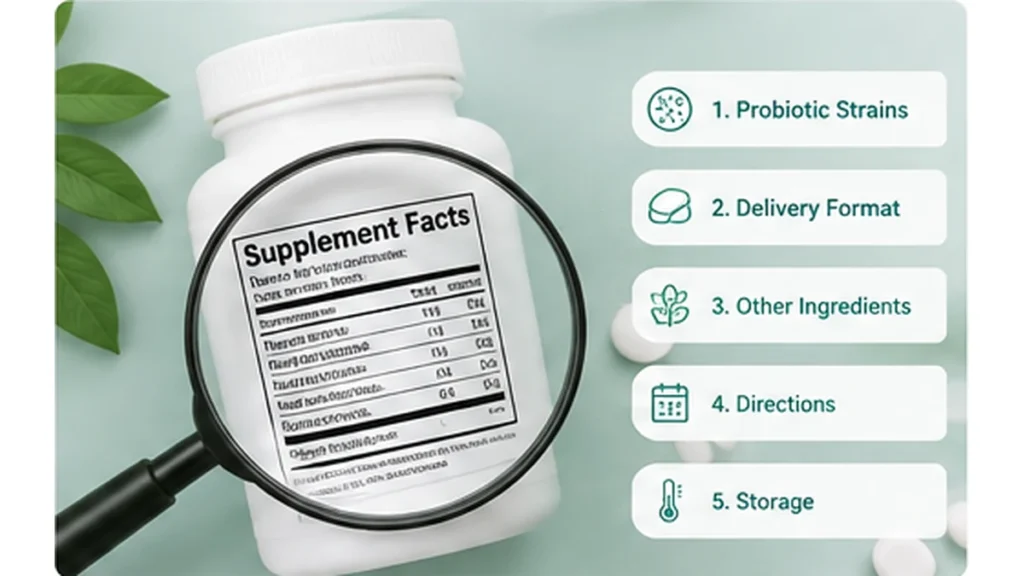
The word “probiotic” on the front of a bottle does not tell you very much by itself.
Probiotics are living microorganisms, and different species — and even different strains within the same species — may behave differently.
That matters because probiotic research is often strain-specific.
A study involving one particular strain does not automatically mean that every probiotic containing a similar type of bacteria will provide the same result.
When comparing products, look for a label that clearly identifies the microorganisms included in the formula.
For example, instead of simply saying:
“Probiotic Blend”
a more informative label will usually provide the names of the organisms contained in that blend.
You do not need to become a microbiologist before buying a supplement. But knowing exactly what is inside the product makes it easier to evaluate what you are paying for.
What to check
Before buying, see whether the manufacturer clearly lists:
- the probiotic species or strains,
- the amount or quantity provided,
- the recommended serving,
- and any additional ingredients included in the formula.
If the product makes impressive claims but provides very little information about what is actually inside it, that is a reason to look more carefully.
2. Make Sure It Is Actually Designed for Oral Use
Many people are already familiar with probiotics for digestive health.
That can create an understandable assumption:
If probiotics are beneficial for the gut, can’t I simply use any probiotic for my mouth?
Not necessarily.
The mouth and digestive tract are different environments.
An oral probiotic is generally formulated with the mouth in mind. Depending on the product, the microorganisms may be delivered through a lozenge, chewable tablet, or another format intended to spend some time in contact with the mouth.
A conventional gut probiotic, on the other hand, may be designed primarily to reach the digestive system.
That does not automatically make one type “better” than the other. They simply serve different purposes.
If your goal is specifically to explore support for the oral microbiome, start by choosing a product that is clearly marketed and formulated for oral use. It can also help to understand how the oral microbiome affects everyday dental wellness before comparing products.
Check the directions too
The serving instructions can tell you a lot.
Some oral probiotics may be intended to dissolve slowly in the mouth. Others may be chewed or used at a particular time of day.
Always follow the current instructions on the product rather than assuming that every probiotic should be swallowed like a standard capsule.
3. Compare the Delivery Format
Even a well-formulated supplement is not very useful if you dislike taking it.
That is why delivery format matters more than many shoppers realize.
Oral probiotics commonly come in forms such as:
- lozenges,
- chewable tablets,
- dissolvable tablets,
- powders,
- or capsules.
There is no single format that is automatically right for everyone.
Think about what you would realistically use every day.
If you already take several capsules with breakfast, another capsule may feel convenient.
If the product is meant to interact with the oral environment before being swallowed, however, a lozenge or chewable format may make more practical sense.
Taste also matters.
A product that tastes unpleasant or feels inconvenient can quickly become something that sits unused in a cabinet.
Ask yourself a simple question
Could I comfortably follow these directions every day for several weeks?
If the answer is no, the product may not be a good match regardless of how attractive the ingredient list looks.
Consistency is usually more realistic when the supplement fits naturally into habits you already have.
4. Read the Full Ingredient List — Not Just the Probiotics
The probiotic strains may be the main attraction, but they are not necessarily the only ingredients in the product.
Oral probiotic formulas can also contain:
- sweeteners,
- flavoring agents,
- plant-derived ingredients,
- vitamins or minerals,
- fillers,
- binding ingredients,
- or other components used to create the tablet or lozenge.
That does not mean these ingredients are automatically problematic.
It simply means they should not be ignored.
People with food allergies, sensitivities, dietary restrictions, or other individual concerns should pay particular attention to the complete ingredient list.
You may also want to compare how complicated the formulas are.
Some consumers prefer a relatively simple probiotic product. Others are comfortable with formulas that combine probiotics with additional wellness ingredients.
Neither approach is automatically superior.
The important part is understanding exactly what you are buying rather than assuming every ingredient is there because it is necessary.
Watch for vague formulas
Transparency is especially useful when supplements contain multiple ingredients.
If the label uses broad terms without clearly explaining what is included, comparing that product with alternatives becomes much more difficult.
A good purchasing decision starts with information you can actually evaluate.
5. Be Careful With Big Numbers and Bigger Claims
Supplement labels often use numbers to attract attention.
With probiotics, one of the most common is CFU, or colony-forming units.
Seeing a product advertise billions of microorganisms can sound impressive.
But a larger number does not automatically mean a better oral probiotic.
The identity of the microorganisms, the way the product is formulated, how it is stored, and how it is intended to be used can all matter.
Choosing a probiotic based only on the largest number on the label is a little like choosing a laptop based only on storage capacity.
It tells you something — but not enough to make a complete decision.
Marketing claims deserve the same caution.
Be skeptical of products promising things such as:
- guaranteed results,
- dramatic changes within a few days,
- permanent solutions,
- replacement for professional dental treatment,
- or benefits that sound too broad for one dietary supplement.
Oral wellness is influenced by many factors, including brushing, interdental cleaning, diet, saliva, smoking, medications, hydration, and existing dental conditions.
No probiotic replaces those fundamentals.
A trustworthy product should fit into an oral-care routine, not claim to make the rest of that routine unnecessary.
6. Compare Cost Based on Actual Use
The price on the front page is not always the most useful number.
Suppose Product A costs $30 and Product B costs $45.
At first glance, Product A looks cheaper.
But what if Product A contains a 20-day supply while Product B contains a 30-day supply?
The difference becomes much smaller once you calculate the cost per day.
That is why it helps to compare:
Price ÷ number of servings = approximate cost per serving
You should also check:
- how many servings are included,
- how often the product is taken,
- whether shipping is extra,
- whether discounts require purchasing multiple bottles,
- and whether a subscription is automatically included.
Bundle pricing can sometimes reduce the cost per bottle, but that does not necessarily mean you should buy six months of a product you have never tried.
For a first purchase, flexibility may be more valuable than the lowest possible price per bottle.
Check the refund terms
Before ordering, look at the current refund or return policy as well.
Find out:
- how long the return window lasts,
- whether opened products qualify,
- whether return shipping is your responsibility,
- and how refunds are requested.
Policies can change, so verify the current terms directly on the seller’s website rather than relying entirely on an older review.
7. Decide Whether It Fits Your Existing Oral-Care Routine
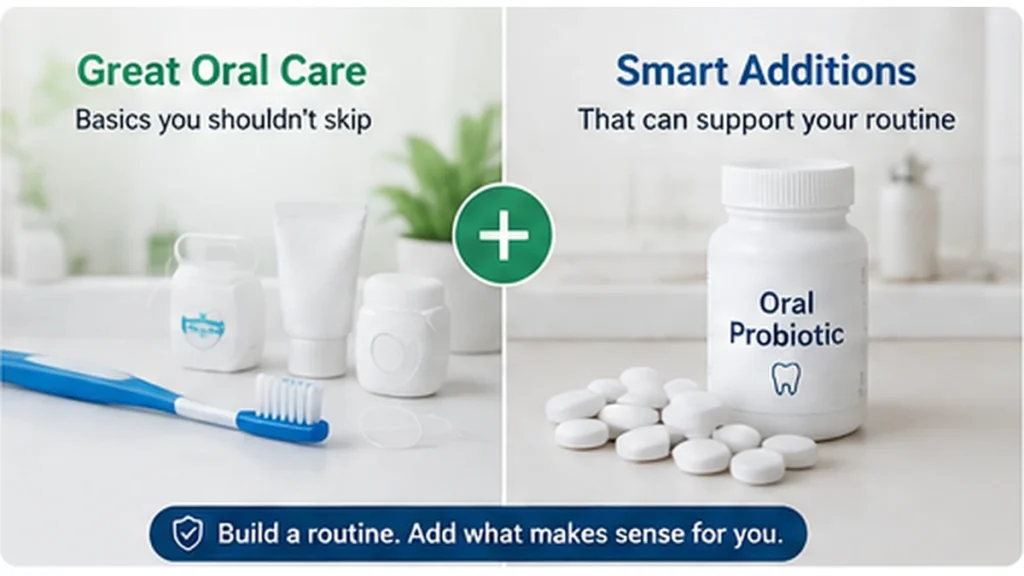
This may be the most important factor of all.
An oral probiotic should be viewed as an optional addition to oral care. If you want to strengthen the basics first, see our practical morning-to-night oral care routine.
It should not become the foundation of your routine.
That foundation still includes habits such as:
Brushing → cleaning between the teeth → appropriate nutrition and hydration → regular professional dental care
Depending on your individual needs, fluoride toothpaste and other products recommended by your dentist may also play an important role.
An oral probiotic can sit alongside those habits.
It cannot physically remove plaque.
It cannot repair a cavity.
And it should not be used to delay professional care when you have ongoing symptoms.
Before buying, ask yourself why you are considering the supplement.
If the answer is:
“I already have a consistent oral-care routine and I’m interested in exploring the oral microbiome.”
That is a reasonable starting point for further research.
If the answer is:
“I want something that will let me stop flossing or avoid going to the dentist.”
Your expectations need to change before choosing any probiotic product.
A Simple Oral Probiotic Comparison Checklist
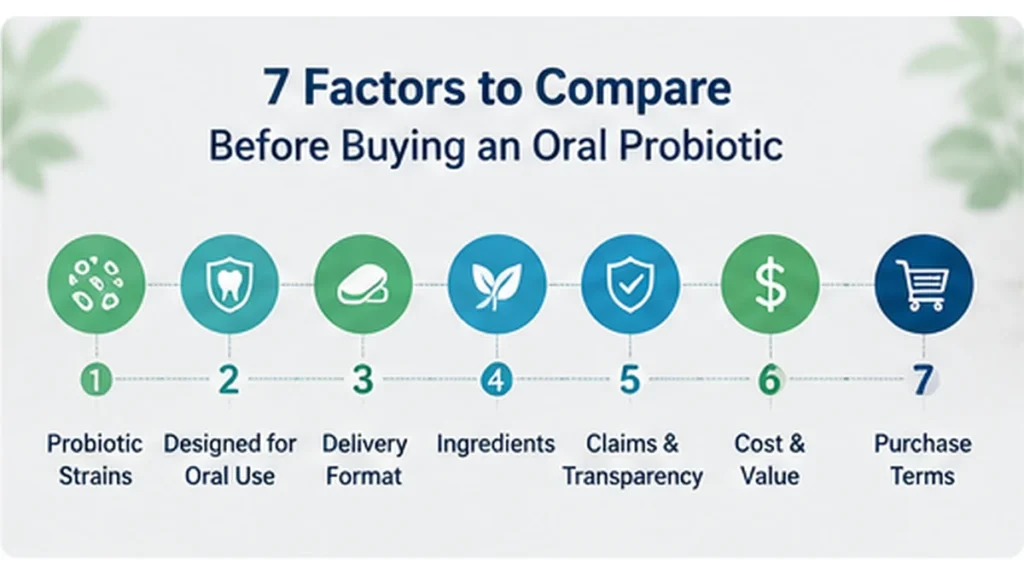
When you are looking at two or three products, you do not need a complicated spreadsheet.
Compare these basics:
Strains
Are the included microorganisms clearly identified?
Purpose
Is the formula specifically designed for oral use?
Format
Is it a lozenge, chewable, powder, capsule, or another format?
Directions
Can you realistically follow the recommended routine?
Ingredients
Are all active and inactive ingredients clearly disclosed?
Claims
Does the company use realistic language, or does it promise dramatic results?
Cost
What is the approximate cost per serving or per month?
Purchase terms
Are shipping, subscriptions, bundles, and refund policies clearly explained?
If one product makes this information easy to find while another hides it behind marketing language, that difference is worth considering.
Want to See How These Factors Apply to a Real Product?
One oral probiotic you may come across while comparing options is ProDentim. If you are considering it, review the current ingredient information, directions, pricing, bundle options, shipping terms, and refund policy before deciding whether it fits your needs.
Check Current ProDentim Details and Availability →
Affiliate disclosure: We may earn a commission if you purchase through this link, at no additional cost to you. This does not affect our editorial approach or the information presented in this guide.
What About Oral Probiotics for Bad Breath?
Bad breath is one reason many people become interested in oral probiotics.
However, bad breath can have several causes.
Common contributors can include:
- tongue coating,
- food and beverages,
- dry mouth,
- smoking,
- poor oral hygiene,
- gum problems,
- or other health conditions.
Because of that, an oral probiotic should not automatically be treated as the answer to persistent bad breath. Dry mouth can also contribute to oral discomfort and breath concerns, so you may also find our guide to common causes of dry mouth and everyday ways to support oral comfort useful.
If the problem continues despite normal oral hygiene, consider discussing it with a dentist or another appropriate healthcare professional.
The same principle applies to bleeding gums, tooth pain, swelling, loose teeth, or other persistent symptoms.
Supplements should not delay appropriate evaluation.
Do You Need the Most Expensive Oral Probiotic?
No.
A higher price does not automatically mean a better product.
Premium pricing may reflect branding, packaging, additional ingredients, marketing costs, or other factors that have little to do with whether the supplement is a good match for you.
At the same time, choosing the cheapest option purely to save money can also be misleading if the formula is poorly explained or provides fewer servings.
Instead of asking:
“Which product is the cheapest?”
try asking:
“Which product gives me the clearest formula, reasonable directions, transparent purchasing terms, and a price I can comfortably maintain?”
That is a much more useful comparison.
How Long Should You Evaluate an Oral Probiotic?
There is no universal timeline that applies to everyone.
Responses to dietary supplements can vary, and oral wellness is influenced by many habits beyond probiotic use.
This is another reason to be cautious when a company promises a guaranteed transformation within a specific number of days.
If you decide to try an oral probiotic, use it according to the manufacturer’s current instructions and pay attention to how well it fits your routine.
Do not increase the serving simply because you want faster results.
And if you experience an unexpected reaction or have concerns about whether the supplement is appropriate for you, stop and speak with an appropriate healthcare professional.
Who Should Be More Careful Before Using an Oral Probiotic?
Most people shopping for supplements can review products on their own, but some situations deserve additional caution.
Consider speaking with a physician, dentist, pharmacist, or another qualified healthcare professional before using a probiotic supplement if you:
- have a weakened immune system,
- have a serious or complex medical condition,
- take medications that affect immune function,
- are pregnant or breastfeeding,
- are considering a supplement for a child,
- or have persistent dental or oral symptoms that have not been evaluated.
“Natural” and “available without a prescription” do not automatically mean that a product is appropriate for every person.
Frequently Asked Questions
Are oral probiotics the same as gut probiotics?
Not necessarily.
Many conventional probiotics are formulated primarily for digestive wellness, while oral probiotics are designed around the microbial environment of the mouth. Their strains, delivery formats, and directions may therefore differ.
Is a higher CFU count always better?
No.
A larger CFU number does not automatically make one probiotic superior. Strain selection, formulation, storage, serving instructions, and the intended use of the product should also be considered.
Can oral probiotics replace brushing and flossing?
No.
Probiotics cannot physically remove plaque or debris from teeth. Brushing and appropriate interdental cleaning remain fundamental parts of oral hygiene.
Should I choose a lozenge or capsule?
It depends on the product and its intended use.
Some oral probiotics are designed to dissolve or remain in contact with the mouth for a period of time, while others may use different delivery formats. Follow the specific product instructions rather than assuming every format works the same way.
Are expensive oral probiotics better?
Not automatically.
Price should be compared alongside the ingredient list, strain transparency, number of servings, directions, purchasing terms, and how well the product fits your routine.
Can an oral probiotic help with bad breath?
Oral probiotics are sometimes marketed for people concerned about breath freshness, but bad breath can have many causes. Persistent bad breath should not be self-treated with supplements alone, especially if it continues despite good oral hygiene.
Final Thoughts
Choosing an oral probiotic does not need to be complicated.
Instead of searching for the product with the biggest number, longest ingredient list, or most dramatic advertising, focus on the information that actually helps you compare your options.
Look for a product that clearly identifies its probiotic strains, is designed for oral use, comes in a format you can realistically use, provides a transparent ingredient list, makes reasonable claims, and offers clear pricing and purchasing terms.
Most importantly, remember where an oral probiotic belongs in the bigger picture.
It is an optional supplement.
Your everyday oral-care habits still do most of the heavy lifting.
A good oral probiotic should complement those habits — not promise to replace them.
If you want to compare one current option after working through the seven factors above, you can review the current ProDentim formula, pricing, and availability here →.
Affiliate disclosure: If you purchase through this link, we may receive a commission at no additional cost to you.
Medical Disclaimer: This article is provided for general informational and educational purposes only and is not intended as medical, dental, diagnostic, or treatment advice. Dietary supplements may affect individuals differently. Consult a qualified dentist, physician, pharmacist, or other appropriate healthcare professional regarding individual symptoms, medical conditions, medications, or supplement use.