
Many people grew up hearing that you should see a dentist every six months. But is that really the rule for everyone? And what actually happens during a routine check-up?
The answer is more personal than many people expect. Health services such as the NHS now recommend that the gap between check-ups depends on your own oral health and risk of problems. This guide explains how often you may need a check-up, what a dentist looks for, how to make the most of your appointment, and when you should not wait for your next routine visit.
This article is for general educational purposes and is not a substitute for professional advice. Please see our medical disclaimer.
Why Dental Check-Ups Matter
According to the NHS, a check-up allows your dentist to see whether you have any dental problems and helps you keep your mouth healthy. Leaving problems untreated can make them more difficult to treat later, so it is best to deal with them early or, if possible, prevent them altogether.
This matters because many common problems are painless at first. Early tooth decay often has no symptoms, and early gum disease can be painless too. Our guides to tooth decay and gingivitis vs. periodontitis explain why catching these problems early makes treatment simpler.
How Often Should You Have a Dental Check-Up?
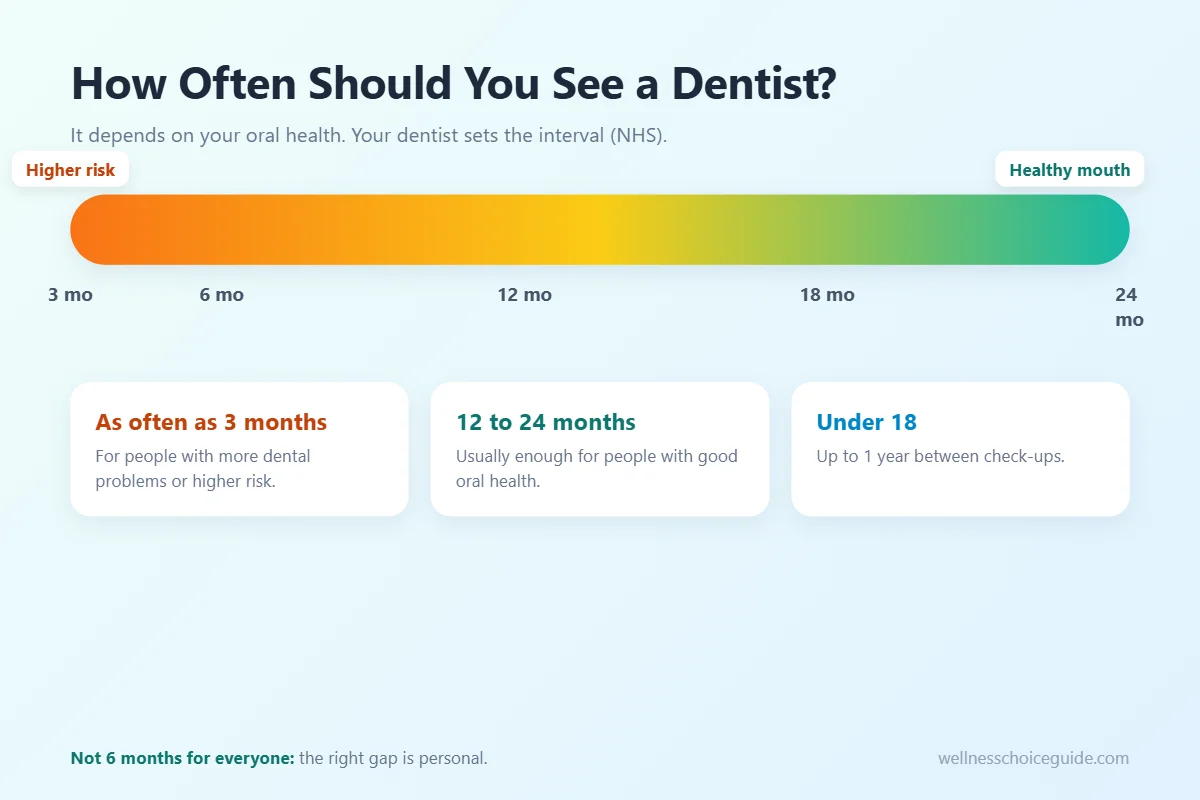
The NHS explains that you may assume you need a check-up every 6 months, but some people may not need to go so often and others may need more frequent checks. Your dentist should suggest when to have your next check-up based on how healthy your teeth and gums are and your risk of future problems.
- The range: the time between check-ups can vary from 3 months to 2 years.
- Under 18s: up to 1 year between check-ups.
- Good oral health: people with healthy teeth and gums will probably need to attend only once every 12 to 24 months.
- More problems: people with more dental problems will need check-ups more often.
In general, the lower your risk of dental problems, the longer you can wait before your next check-up. The NHS also advises seeing a dentist if you have not had a check-up for 2 years, or 1 year if you are under 18.
What Happens During a Dental Check-Up?
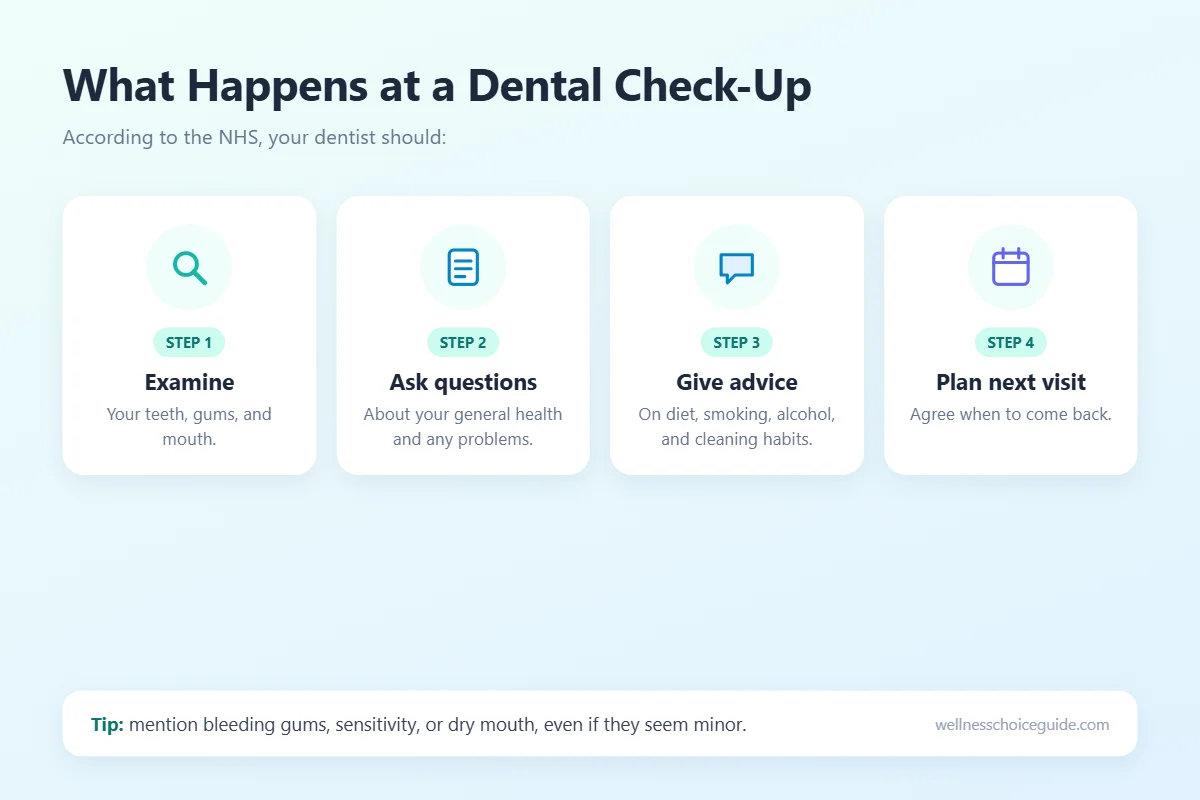
According to the NHS, at each check-up your dentist should:
- examine your teeth, gums, and mouth;
- ask about your general health and any problems you have had with your teeth, mouth, or gums since your last visit;
- ask about, and give you advice on, your diet, smoking and alcohol use, and teeth-cleaning habits;
- discuss a date for your next visit.
Checking Your Gums
The National Institute of Dental and Craniofacial Research (NIDCR) explains that a dentist may use a tiny ruler called a probe to measure the spaces around your teeth, known as pockets. In a healthy mouth, these pockets are usually 1 to 3 millimeters deep. Deeper pockets can be a sign of gum disease.
X-Rays
Your dentist may sometimes recommend X-rays. The NIDCR notes that an X-ray can show whether there is any bone loss from gum disease. X-rays can also help a dentist spot problems that are hard to see during an exam.
Routine Check-Ups vs. Other Dental Appointments
The NHS points out that its check-up advice is about routine check-ups only. You may need other appointments for treatments such as fillings, having a tooth removed, or emergency care. Your dentist may also suggest a cleaning with a dental hygienist, since only a professional cleaning can remove hardened tartar. Our guide to plaque vs. tartar explains why.
How to Make the Most of Your Check-Up
A little preparation can make your appointment more useful:
- Mention any changes, even small ones, such as bleeding gums, sensitivity, dry mouth, or a sore that has not healed.
- Tell your dentist about your health and medicines, since some conditions and medicines affect your mouth.
- Be honest about habits such as smoking, snacking, or grinding your teeth.
- Ask about your cleaning routine. Your dentist can show you where you miss and recommend tools such as interdental brushes.
- Ask when you should come back, and why, so you understand your own risk level.
Don’t Wait for Your Next Check-Up If…
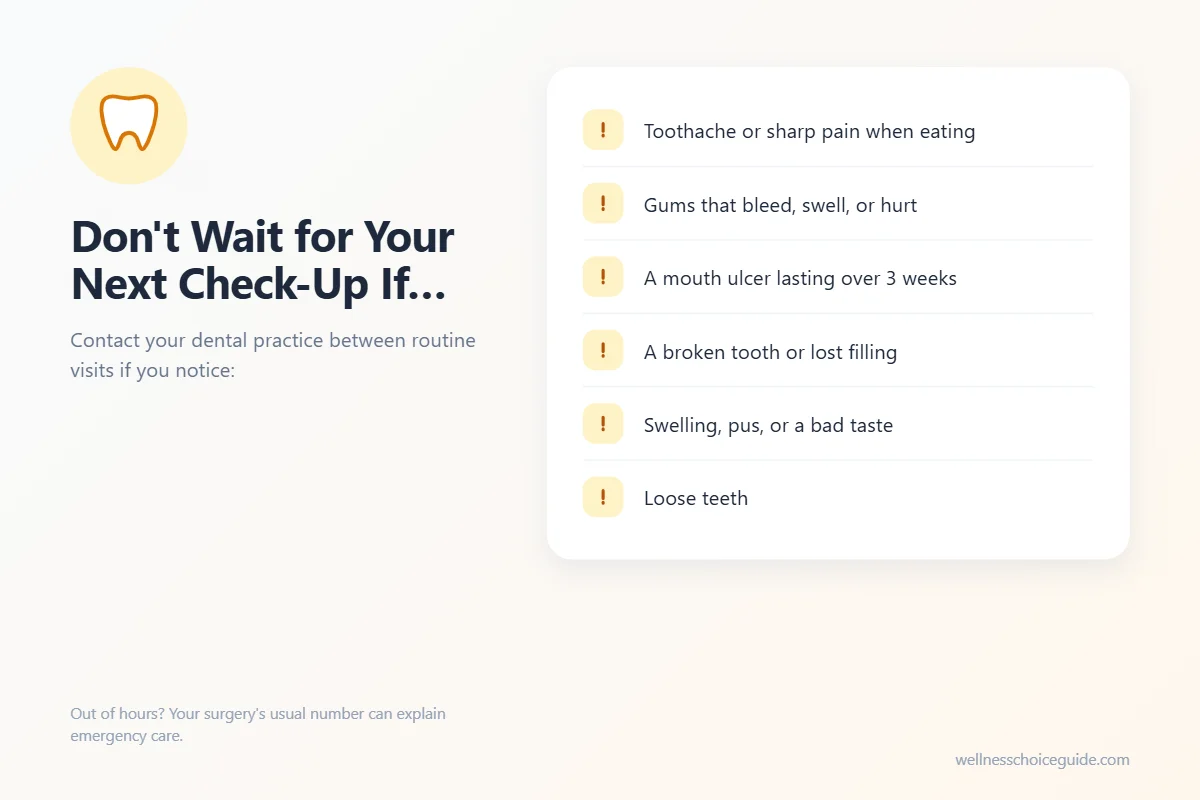
If you have problems between routine visits, the NHS advises contacting your dental surgery to make an appointment. It is worth getting in touch if you notice:
- toothache or a sharp pain when eating or drinking;
- gums that bleed, swell, or hurt;
- a mouth ulcer lasting longer than 3 weeks;
- a broken tooth or a lost filling;
- swelling, pus, or a bad taste, which can be signs of infection;
- teeth that feel loose.
In an emergency outside normal working hours, the NHS suggests calling your dental surgery on its usual number, where you will be told how to access emergency dental care.
Dental Check-Ups for Children
Children’s teeth need regular attention too. The NHS says the gap between check-ups for under 18s can be up to 1 year, depending on their oral health. Regular visits also help children get used to the dentist, which can make future appointments easier.
At home, the NHS recommends using only a smear of fluoride toothpaste for children under 3 and a pea-sized amount for children aged 3 to 6, and encouraging children to spit out toothpaste after brushing rather than rinsing. It also advises seeing a dentist if your child has sore or bleeding gums. Our guide to fluoride toothpaste covers the right amounts by age.
Looking After Your Teeth Between Visits
Check-ups work best alongside good daily habits:
- brush twice a day with fluoride toothpaste, and spit rather than rinse;
- clean between your teeth daily with floss, interdental brushes, or a water flosser;
- cut down on how often you have sugary foods and drinks;
- don’t smoke.
Our daily oral care routine guide brings these habits together.
Frequently Asked Questions
Do I need a dental check-up every 6 months?
Not necessarily. According to the NHS, the gap can range from 3 months to 2 years depending on your oral health. Your dentist will recommend what is right for you.
How long can I go without a dental check-up?
The NHS advises seeing a dentist if you have not had a check-up for 2 years, or 1 year for under 18s.
Do I need a check-up if nothing hurts?
Yes. Many problems, including early tooth decay and gum disease, do not cause pain at first. Regular check-ups help catch them early.
Is a dental check-up the same as a cleaning?
Not always. A check-up is an examination. A professional cleaning, often by a hygienist, may be recommended separately to remove tartar.
The Bottom Line
There is no single schedule that suits everyone. The NHS says the time between dental check-ups can range from 3 months to 2 years, depending on your oral health and risk of problems, and your dentist will recommend the right interval for you.
Use your check-up to mention any changes and ask questions, and don’t wait for your next routine visit if you have pain, swelling, bleeding gums, or a sore that does not heal.
Sources and Further Reading
- NHS: Dental check-ups
- NHS: Gum disease
- NHS: Taking care of children’s teeth
- National Institute of Dental and Craniofacial Research: Gum (Periodontal) Disease